
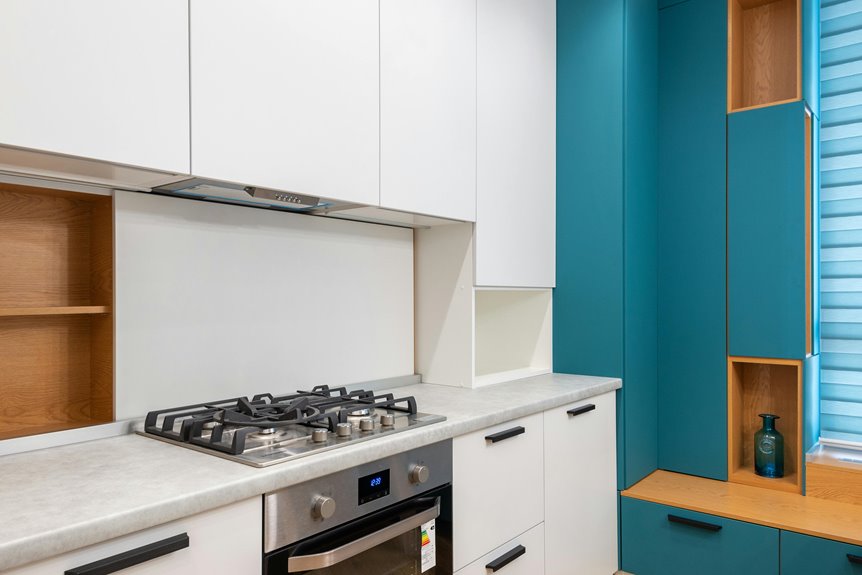
You’ll want to measure 2–3 inches from each door’s edge and center your knobs horizontally. This spacing keeps things looking balanced and makes them easy to grab. Use painter’s tape to mark where each knob goes before you drill any holes—it’s much easier to reposition tape than to fill in a misplaced hole.
Test your reach before you finalize anything. Stand in front of your cabinet and pretend to open it. Your hand should land naturally on the knob without stretching or awkwardly bending your wrist.
Pick a knob style that matches your kitchen’s look. Brass and gold finishes work well for traditional cabinets, while matte black suits modern designs better. Stainless steel works as a solid middle ground if you’re not sure. Keep all your hardware in the same finish throughout the kitchen so everything looks intentional rather than cobbled together.
A hardware jig—a simple tool that costs around $15 to $30—helps you drill holes at the same depth and angle on multiple doors. It’s worth grabbing if you’re doing more than just a few cabinets. Check that your doors swing open without hitting the knobs, especially if you have tight spaces between cabinet units. Some doors need knobs positioned higher or lower depending on how much clearance you actually have.
Step 1: Determine Your Cabinet Type and Height Range
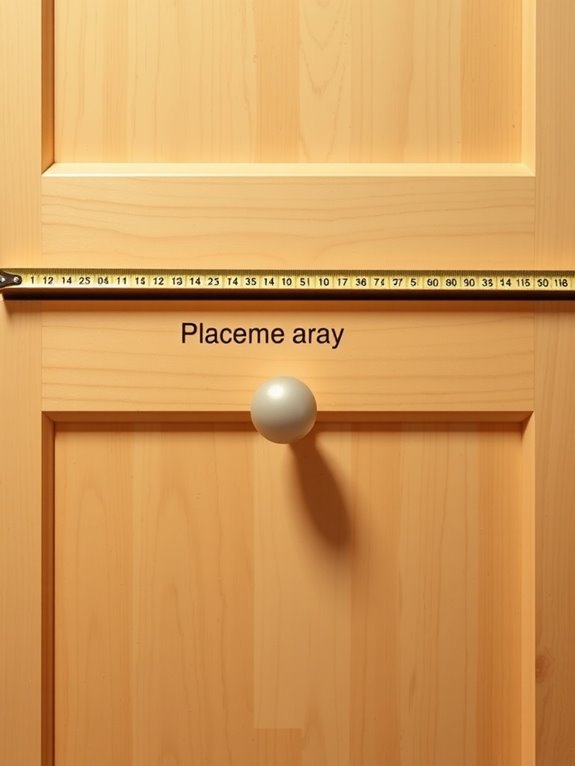
Why does your cabinet type matter so much? Because it determines where you’ll naturally reach and how your kitchen looks as a cohesive whole. You’ve got three main players: base cabinets sit at floor level, wall cabinets live above your counters, and tall pantry cabinets stretch from floor to ceiling.
Each type has its own sweet spot for knob placement. Base cabinets need knobs positioned 2–3 inches from the top or bottom corner near the door edge for easy grabbing. Wall cabinets work best with knobs 2–3 inches from the lower edge, matching your typical reach zones. Tall cabinets call for centered or lower-third placement to keep things visually balanced.
When you match your knob placement to your cabinet height and type, everything lines up nicely with the rail and stile lines. This creates a uniform look throughout your kitchen instead of a scattered, random feel. It’s one of those details that seems small until you notice it done right—then it just clicks into place.
Step 2: Measure 2–3 Inches From the Door Edge for Consistency
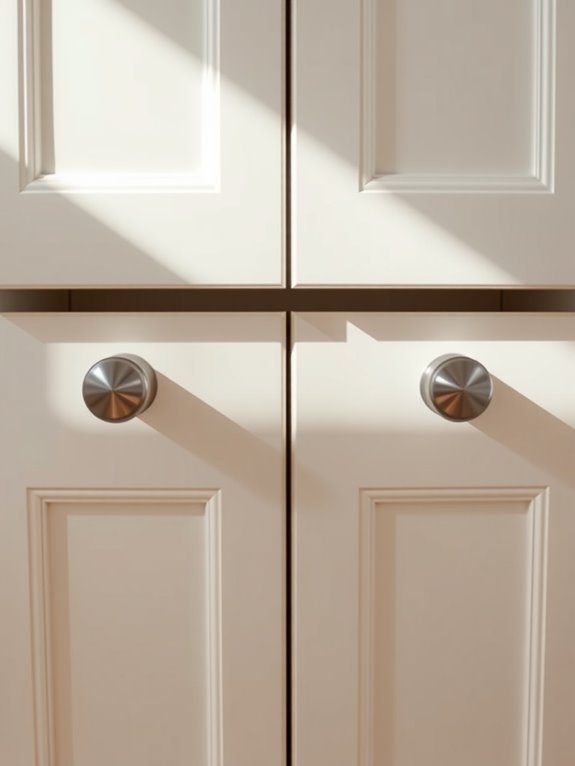
How do you get your knobs in the right spot every single time? The answer is simpler than you’d think. The 2–3 inches from edge measurement guide keeps your cabinet hardware placement looking consistent across your whole kitchen.
Start by measuring 2–3 inches from the top or bottom door edge. Use painter’s tape or a straightedge to mark your exact spot so you can see where you’re going before you drill anything. Then center the knob horizontally along the door’s width to keep things balanced. Before you commit to drilling, place temporary tape on the spot and test your reach and clearance to make sure the placement actually works for your hand.
This from-edge rule works well because it creates spacing that feels natural when you’re grabbing handles during everyday cooking and cleaning. The measurement gives you that uniform look that people notice, and it puts handles where they’re actually comfortable to grab. Most cabinet doors are between 14 and 20 inches wide, so centering the knob on a standard 16-inch door means placing it roughly 8 inches from either vertical edge, then measuring 2–3 inches down from the top or up from the bottom.
Step 3: Center Knobs on Doors and Drawers
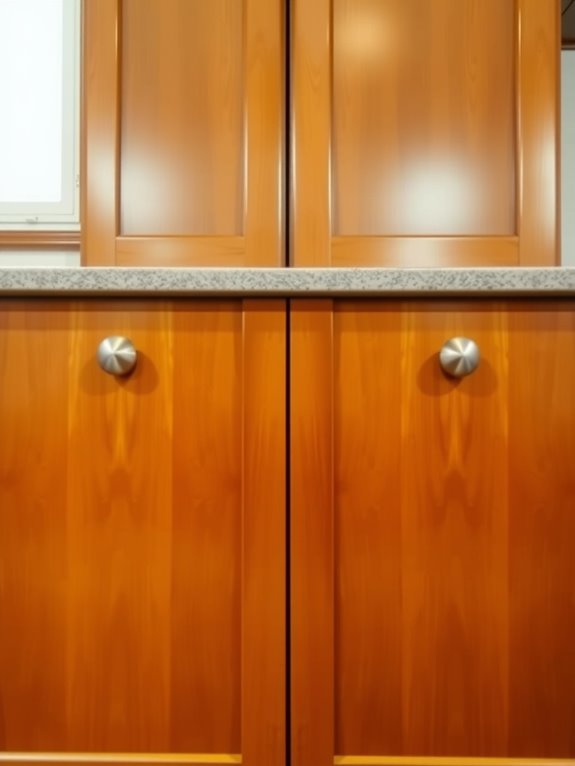
Now you’ll want to get both the vertical and horizontal alignment right so your knobs look neat and professional. For vertical alignment, decide how far down (or up) from the edge you want each knob, then use that same measurement on every cabinet. This consistency is what makes everything feel coordinated rather than random.
Horizontal centering means placing each knob so it sits left-to-right in the middle of the door. This balanced placement looks intentional instead of lopsided. A simple approach: measure your door width, mark the center point with a pencil, and line up your knob there. Most standard cabinet doors are about 15 to 18 inches wide, so your center point will fall somewhere in the middle—not too close to either edge.
Use a level or a measuring tape to double-check your marks before drilling. If you’re working with drawers instead of doors, the same logic applies, though drawers are usually narrower so there’s less room to play around with placement. A standard 12-inch drawer works well with the knob centered about 6 inches from either side.
Vertical Alignment Techniques
Once you’ve marked your horizontal placement, it’s time to figure out the vertical positioning. This is the part where your cabinet doors actually start looking polished because you’re making sure the knobs line up nicely across the whole run.
How you position your knob vertically depends on how tall your doors are and what style your cabinets have. Here’s what works:
Use a reference line – Grab a level and draw a light vertical line down your cabinet doors. This helper line keeps your knob placement consistent from one door to the next, which matters more than you’d think when you’re looking at the cabinet straight-on.
Position knobs in the middle of tall doors – For standard cabinet doors, aim for roughly the center point. This creates balanced visual weight so your eye doesn’t get pulled up or down when you’re looking at the cabinet face.
Keep 2-3 inches from the edges – Leave some breathing room between your knob and the top or bottom of the door. You need this space for your hand to actually grab the knob without your fingers hitting the frame, and it also looks more proportional.
Line up with the door’s frame – If your cabinet doors have a frame or stile (that’s the vertical piece around the edge), position your knob’s center point to match those existing lines. It ties the whole thing together visually without looking random.
Horizontal Centering Methods
Why does centering matter so much when you’re installing knobs? Centered knobs look intentional and polished—they’re what separates a DIY project from professional work. For cabinet doors, align your knobs horizontally with the door’s vertical center. For drawer fronts, position a single knob in the middle, leaving equal spacing on both sides. When you’re using two pulls on wider drawers, space them evenly about 3–4 inches from each side toward the center for balanced alignment.
Before you drill any holes, grab some painter’s tape (a standard roll costs around $3–5 at any hardware store) as temporary guides. Mark your horizontal centering lines with a pencil, then apply tape along those guides to double-check your spacing. This simple step prevents costly mistakes and keeps your knobs and pulls looking like you planned every detail.
Step 4: Align Knobs With Cabinet Rails for Cohesion
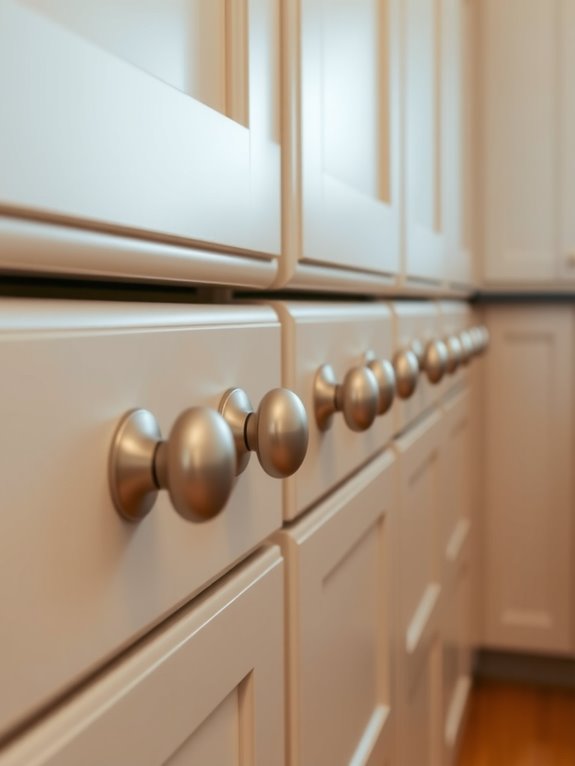
To create a cohesive look in your kitchen, align your knobs with the cabinet’s horizontal lines—the rails. This simple alignment choice makes your hardware look like you planned it that way, which honestly, you did.
Start by identifying your cabinet rails. These are the horizontal wood pieces that frame each door panel. Once you spot them, you’re halfway there.
Position every knob at the same height along these rails. If your cabinet doors share a rail, line them all up identically. This creates a visual rhythm that your eye will follow naturally from one door to the next.
Keep knobs 2–3 inches from the corners. This distance balances how easy they are to grab with how they look on the door. Too close to the edge and they feel cramped. Too far and they look awkward.
The whole point here is making your hardware work as a visual thread through your kitchen rather than looking like you just grabbed whatever knob was closest and called it a day.
Step 5: Choose a Knob Style That Matches Your Design
Now that you’ve mapped out where your knobs go, it’s time to pick a style that fits your kitchen. Classic brass pulls work well on raised-panel doors, while sleek matte black knobs suit modern flat fronts. Whatever style you choose, stick with the same material and finish across all your cabinets. Mixing finishes can make your kitchen look like you shopped at five different stores.
Size matters too. A standard 1-1/4 inch knob works on most cabinet doors and keeps things looking balanced. If you go bigger, your cabinets might feel bold and statement-making. Go smaller, and they’ll blend more into the background. The choice depends on what feel you’re going for.
For brass options, brands like Liberty Hardware offer basic pulls around $2-4 each, while higher-end choices like Anthropologie’s brass knobs run $8-12. If matte black is your preference, IKEA stocks simple options for under $2, and mid-range retailers like Wayfair have quality versions between $4-8. The finish you pick will be there every time you open a cabinet, so choose something you actually like to touch and look at.
Traditional vs. Contemporary Styles
Have you noticed how a kitchen’s personality shows up in its hardware. Your knob choice sets the entire tone for the room.
Traditional hardware features warm finishes like antique brass or bronze, with rounded knobs that feel timeless and inviting. These styles work well in kitchens with classic cabinetry and older home designs.
Contemporary hardware showcases sleek, minimal designs in polished nickel, emphasizing clean lines and understated elegance. You’ll often see these knobs on flat-panel cabinets in modern kitchens.
The way you place your hardware matters too. Traditional spaces center knobs on cabinet doors for a balanced look, while modern kitchens often align knobs along the top edge for a streamlined appearance.
When picking your hardware, match the finish to your cabinetry palette. Antique brass pairs nicely with warm wood tones, while polished nickel complements white or gray cabinets. Brands like Liberty Hardware offer options in both styles, with traditional knobs typically running $2-5 each and contemporary designs around $3-6 per piece.
Your knob style reinforces your overall design vision, whether you’re embracing vintage charm or a modern look. The right door knobs make cabinets feel more intentional and less purely functional.
Material and Finish Consistency
Once you’ve decided whether your kitchen style leans traditional or modern, the next step is picking one metal finish for all your cabinet hardware. Whether you go with polished nickel, antique brass, or matte black, using the same finish across every cabinet creates a look that feels planned and organized.
Think of your hardware finish like the thing that holds your whole design together. When your knobs and pulls all match, your kitchen feels connected instead of random. This works even better when your cabinet doors use different wood types or veneers—a single hardware finish smooths out those differences visually and makes everything feel like it belongs in the same space.
The practical side matters too. Sticking with one finish means you can buy hardware in bulk, which usually costs less per piece. It also makes replacements easier down the road since you know exactly what to look for. A basic polished nickel knob from most hardware stores runs around $3 to $8 each, while something like an antique brass option might be $5 to $12. Matte black finishes sit somewhere in the middle at $4 to $10.
Your hardware choice might seem small, but it affects how put-together your whole kitchen actually looks. When everything matches, people notice the kitchen feels right, even if they can’t quite say why.
Scale and Proportion Balance
What size knob actually looks right on your cabinet door? Getting scale and proportion right keeps your kitchen from looking like someone threw random hardware at it. You’ll want to match knob sizing to your cabinet doors and drawer fronts thoughtfully.
Consider these proportional sizing guidelines:
- Standard 1-1/4 inch knobs work for most medium-sized cabinet doors
- Smaller doors benefit from downsized knobs—think 1 inch or less—for cohesive proportional sizing
- Larger doors accommodate bigger knobs (up to 2 inches) or dual-knob configurations
- Drawer fronts typically need slightly smaller hardware than cabinet doors
Your knob placement matters just as much as the size. Position knobs 2–3 inches from edges to maintain visual balance. When you’re standing in your kitchen looking at your cabinets, the hardware should blend in rather than stick out like it doesn’t belong. Match the finish with your existing hardware to keep everything connected. Whether you’re going traditional or modern, proportional sizing means your kitchen hardware works together as one unified design rather than random pieces competing for attention.
Step 6: Use a Template or Hardware Jig for Accuracy
Why spend time drilling holes only to discover they’re misaligned or spaced unevenly? A cabinet hardware jig or template takes the guesswork out of your project. These tools guide your drawer pulls and knobs to exact center alignment and uniform hole spacing across every door and drawer.
Before you drill anything permanent, use painter’s tape to preview your door placement. This simple step prevents costly mistakes on real wood. The Cabinet Hardware Jig PRO offers rapid center extension and repeatable settings, making installation faster and more accurate. USA-made options like True Position Tools provide precise centering and easier alignment when you’re working with multiple pieces. Both knobs and pulls work with these jigs, which guide distances from edges and rail lines so you get that polished, professional look without the headache.
Step 7: Test Door Swing Before Final Installation
Now that you’ve marked your holes perfectly with a jig or template, it’s time to make sure your doors can actually open without hitting anything. Testing your door swing prevents costly mistakes before final installation.
Start by temporarily attaching your cabinet hardware and opening each door fully to check for clearance against countertops, walls, and adjacent cabinetry. Open and close multiple doors in sequence to verify consistent alignment and uniform gaps across the entire run. Use painter’s tape to mark reference points, then simulate door movement to confirm your knob placement won’t obstruct anything.
Also verify the knob height allows comfortable grip when fully opened and doesn’t interfere with appliances or toe-kick space. If interference occurs, adjust your knob placement vertically or horizontally in small increments and re-test. This simple testing step saves you from reinstalling everything later.