
Start by using a stud finder to locate your ceiling joists, then space your fixtures based on your ceiling height. For a 9-foot ceiling, aim for lights about 4.5 feet apart. Use painter’s tape to mark where each light will go before you drill any holes—this preview step saves you from mistakes.
Turn off the power at the breaker before touching any wiring. Run Romex cable through the attic between your fixture boxes, leaving 6–8 inches of slack at each opening. Strip about half an inch of insulation from the wire ends, then connect black wires to black and white wires to white using wire nuts. Mount your LED discs using their spring clips once the wiring is complete.
Test all your lights after installation and set the color temperature around 3,500K for vanity areas, which gives you natural-looking light without being too yellow or too blue. This temperature range works well for applying makeup or shaving without creating harsh shadows on your face.
Dust control matters more than you might think when working in an attic space. A shop vac with a HEPA filter (around $50–$100) catches particles before they fall into your bathroom below. If you’re adding a dimmer switch later, make sure your LED fixtures are dimmer-compatible—many budget LEDs aren’t, so check the packaging before buying.
Plan Your Bathroom Recessed Lighting Layout and Locate Joists
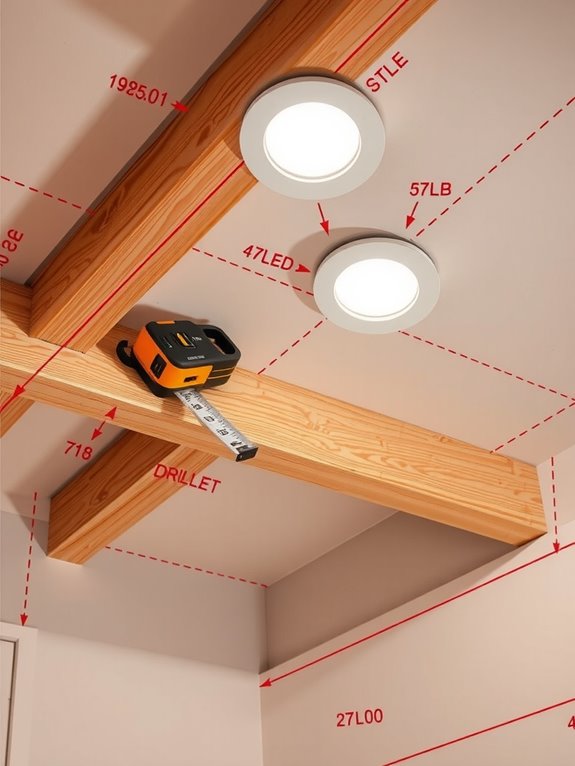
Before you grab your drill, map out exactly where those recessed lights should go. This is basically the foundation for the whole project. Start by dividing your ceiling height by two for initial spacing. A 9-foot ceiling means roughly 4.5 feet between fixtures. Use painters tape to outline potential light locations so you can see how it’ll look before you commit to making holes.
Next, find your joists because they’ll determine what’s actually possible. Probe suspect areas with a screw to confirm joist locations, then adjust your layout if needed. For vanity lighting, symmetry matters quite a bit. If you’ve got 60 inches of vanity space, place two lights 20 inches from each side. This approach gives you balanced illumination that looks good to everyone using the bathroom.
Choose Color Temperature and CRI for Each Bathroom Zone
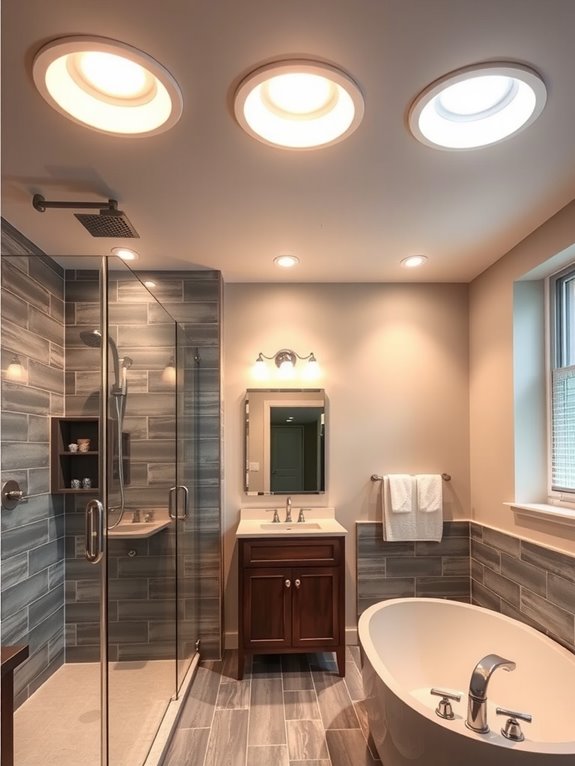
Now that you’ve figured out your bathroom layout, it’s time to pick the right lighting for each zone. Different areas need different types of light, and getting this right makes a real difference in how your bathroom actually functions.
Your vanity needs the best lighting in the room. Look for bulbs with a CRI (color rendering index) of 90% or higher—this means the light shows true colors, which matters when you’re doing makeup or shaving. Aim for cooler temperatures around 3,500–4,000K. This cooler light gives you the clarity you need to see what you’re actually doing. A basic LED vanity strip like the Brightech LED Vanity Light Fixture runs around $30–60 and will handle this job well.
Your vanity deserves high-quality lighting: aim for 90%+ CRI and 3,500–4,000K for true color and clarity.
The shower and toilet areas can work with moderate CRI lighting—somewhere between 85–90%—at similar temperatures to your vanity. These spaces don’t need the same precision as your mirror area, so you have a bit more wiggle room here. You might use a simple recessed light or a moisture-resistant fixture, which typically cost $20–40 per unit.
For the rest of your bathroom—maybe a corner with a towel rack or the general space around the door—you can go warmer. Temperatures between 2,000–3,000K create a more relaxed feeling. This warmer light helps the bathroom feel less clinical and more like a place where you actually want to spend time. The trick is just matching the right color temperature and brightness level to what actually happens in each spot.
Select Fill Lights to Reduce Shadows and Hotspots (Optional)
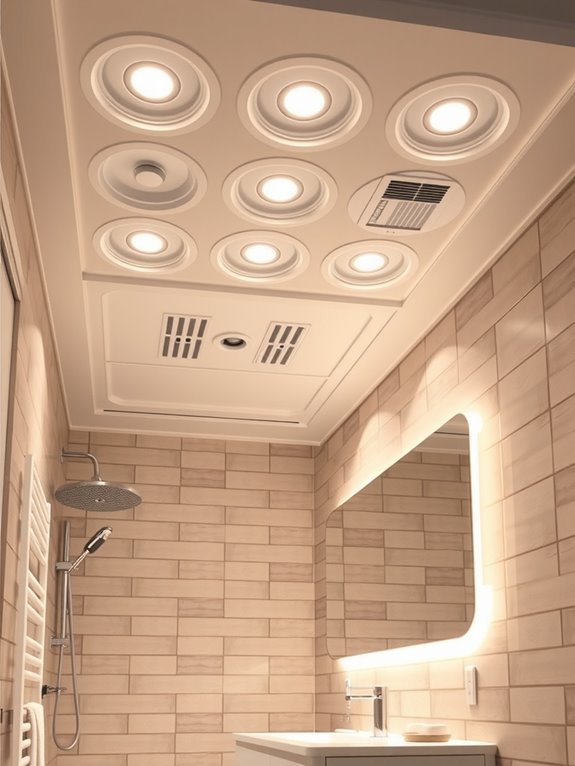
You can use wall sconces and pendant fixtures as fill lights to soften those annoying shadows that vanity lights create around your eyes and cheekbones. Position these supplemental fixtures close to your mirror—about half your vanity’s depth from the wall—so they balance out the main task lighting without creating new problems.
Wall sconces work great on either side of your mirror. If you have the ceiling space and height, pendants hanging above offer another option. The key is placing them strategically so they fill in the dark spots without adding glare or creating harsh shadows of their own. Think of fill lights as backup dancers for your main vanity light—they support the star without stealing the spotlight.
Wall Sconces For Shadow Reduction
How’d you like to eliminate those unflattering shadows that make your face look like a topographical map when you’re getting ready in the morning?
Wall sconces deliver the shadow reduction you’ve been missing. They’re your secret weapon for even bathroom lighting that actually works.
- Position sconces about 66–72 inches from the floor—roughly shoulder height—to blend light distribution and minimize glare in your eyes
- Place them on either side of your vanity mirror to eliminate harsh shadows across your face during makeup application
- Match your sconces’ color temperature with overhead recessed lighting to create balanced, cohesive illumination throughout the space
- Choose damp-rated fixtures with glass diffusers to reduce hotspots and handle bathroom moisture effectively
Pairing sconces with your can lights creates professional-quality bathroom lighting. You’ll actually enjoy looking in that mirror now—no more surprises when you leave home.
Pendant Fixtures As Fill Lights
What if those shadows under your eyes during your morning routine could practically disappear. Pendant fixtures work wonderfully as fill lights alongside your recessed vanity lighting. They’re positioned midway between your vanity edge and overhead fixtures, softening harsh shadows without creating annoying glare.
Choose dimmable LEDs with 2700K–3000K temperature to flatter your skin tone while keeping things cool near wet areas. Pendant fixtures direct light toward reflective surfaces, complementing your task lighting rather than competing with it. You’ll control brightness for different routines—bright for makeup application, dimmer for evening wind-downs.
Mount fill lights on the same circuit with accessible switches or dimmers so you’re never stuck with unflattering lighting. You’ll finally get that balanced, professional look at home without the hassle of managing multiple light sources.
Measure and Mark Your Recessed Light Spacing Grid
Before you start cutting holes in your ceiling, wouldn’t it make sense to map out exactly where those lights should go?
Before you start cutting holes in your ceiling, wouldn’t it make sense to map out exactly where those lights should go?
Your recessed lighting layout determines how well your bathroom actually functions. Here’s how to create your spacing grid:
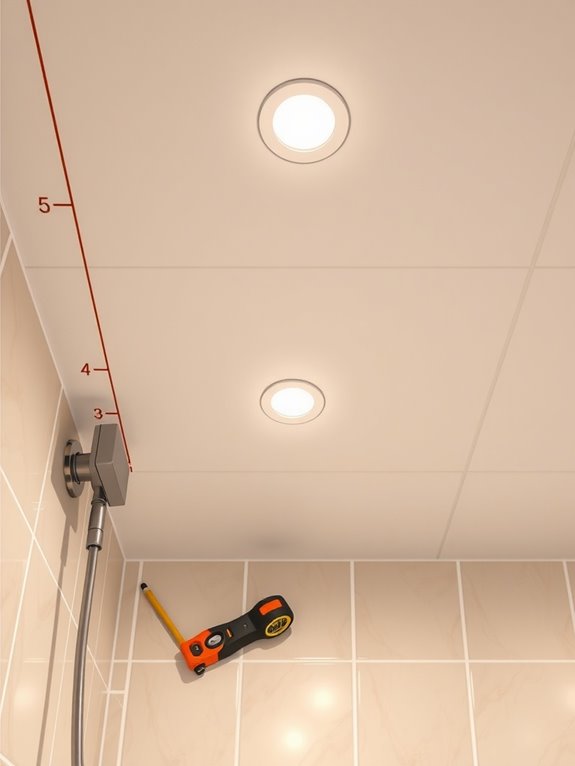
Measure your ceiling height – On a 9-foot ceiling, divide by two and space lights roughly 4.5 feet apart for even distribution. This math-based approach prevents dark spots and gives you confidence before drilling.
Grab painter’s tape – Use this visual guide to mark potential light locations, ensuring symmetry across your bathroom. Blue painter’s tape (around $5 per roll) works better than pencil marks because you can see it from different angles and adjust as needed.
Plan vanity zones – Position lights about 20 inches from each side of your vanity for balanced illumination where you need it most. This placement prevents shadows across your face when you’re getting ready.
Check for joists – Tap with a screw to verify each spot isn’t blocking solid obstruction before committing. If you hit something hard, you’ve found a joist and need to shift your light location slightly. This simple step saves you from wasted drilling and frustration later.
Use Painter’s Tape to Visualize Light Locations
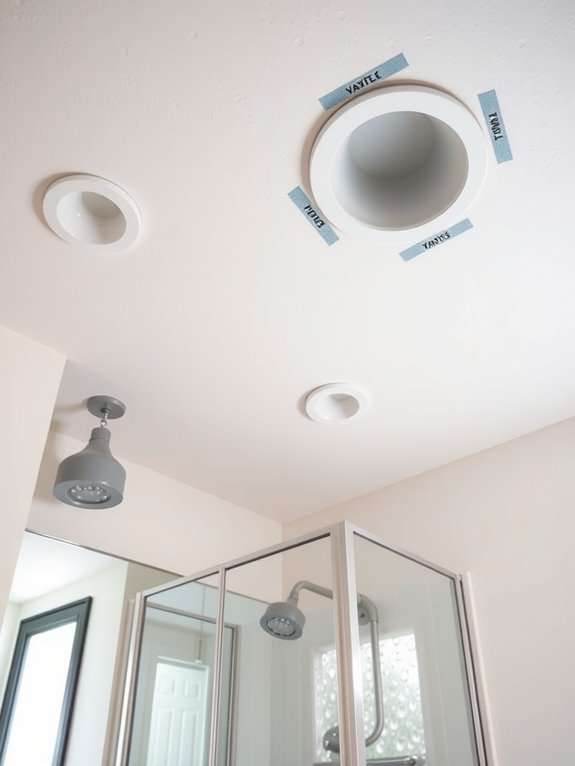
Now that you’ve got your spacing math down and know where the joists are hiding, it’s time to actually see your plan come to life on that ceiling.
Grab some painter’s tape—the standard blue kind works fine and costs around $3 to $5 per roll—and mark your recessed lighting locations directly overhead. This visual guide turns abstract measurements into something real you can actually see. Create an X at each fixture’s center point, using tape as your tactile reference. You’ll map out a two-row pattern that covers vanity, shower, and ambient zones.
| Zone | Fixture Count | Spacing |
|---|---|---|
| Vanity | 2 | 4.5 feet |
| Shower | 2 | 4.5 feet |
| Ambient | 1-2 | Varied |
Step back and evaluate your tape layout from different angles. Does it look balanced. Symmetrical. Stand in the vanity area and look toward the shower. Walk into the shower space itself and check how the lights feel from that vantage point. Most people find they notice spacing issues immediately once they see tape on the ceiling rather than just looking at drawings on paper.
Once you’re satisfied with the layout, the tape stays put until after wiring. Then you’ll remove it, revealing your perfectly placed recessed lights. This simple step saves you from drilling holes and discovering later that fixtures are positioned awkwardly or too close together.
Check Joist Location With a Screw to Avoid Drilling Into Framing
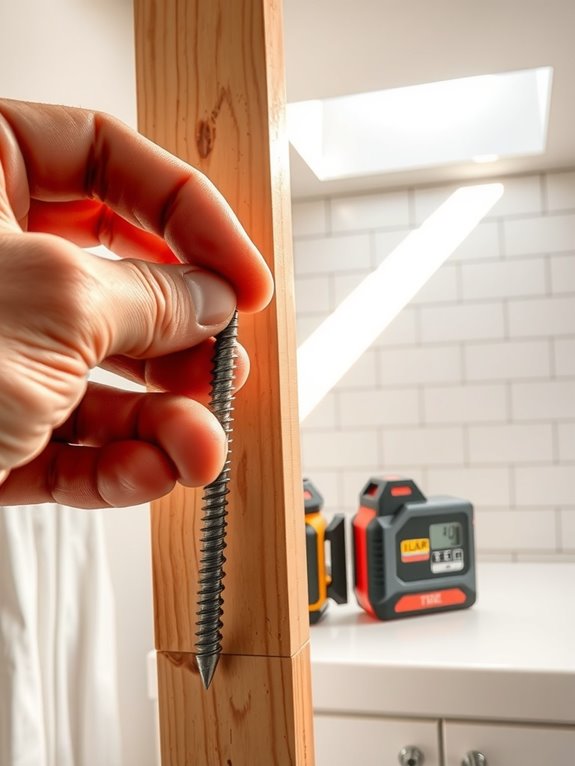
Before you drill into your ceiling for bathroom lights, you need to know where the wooden joists are hiding. A drywall screw is the perfect tool for this job—it costs about $0.10 per screw and takes seconds to use.
Start by grabbing a standard drywall screw (the kind you’d find in any hardware store for under $5 per box of 100) and push it into your ceiling at each spot where you’re thinking about placing a light. Pay attention to how the screw behaves. When it slides in easily without much resistance, you’ve hit the hollow space between joists. That’s your green light for drilling. If the screw suddenly stops and won’t budge, you’ve found solid wood—that’s a joist. Slide your planned light location a few inches over and try again.
Work your way across the ceiling, testing multiple spots to map out where all the joists run. This takes maybe five minutes but prevents you from drilling into a structural member that’s holding up your home. Once you understand the joist pattern, you can pick light locations that give you good spacing while keeping everything safe. You’ll know exactly what you’re dealing with before the actual drilling starts.
Gather Tools and Safety Gear for the Project

Before you start cutting holes in drywall, you’ll need some basic tools and safety gear. An adjustable hole saw cutter works well for making openings at different sizes, and you’ll want one handy before you begin. The dust from drywall is no joke—it gets everywhere and lingers in the air, so grab a respirator that fits properly. ISOtunes ear protection keeps noise from the saw at a manageable level without breaking your focus.
A makeshift dust shield from a half basketball catches a lot of the particles before they spread through your workspace. Set up your Toughbuilt Cliptech tool belt to keep your Romex cable, connectors, and ultra-slim LED fixture within arm’s reach so you’re not hunting for things mid-project.
The safety gear might seem like extra steps, but once you’re dealing with dust particles in your lungs or ringing ears from the saw noise, those five minutes spent putting everything on starts looking pretty reasonable. Wear the respirator, wear the ear protection, and wear the dust shield. Your body will appreciate it while you’re working and long after you’re done.
Essential Safety Equipment
What’s the one thing most DIYers skip before firing up their tools? Safety gear. Installing can lights means you’re cutting drywall, drilling, and creating dust clouds. You’ll want protection that actually works.
Ear protection – ISOtunes or similar earmuffs guard against drilling and cutting noise that’ll ring in your ears for hours. A decent pair runs $20-$50 and makes a real difference when you’re working overhead.
Respirator – A quality mask filters drywall dust when you’re cutting into your ceiling. Look for one rated for fine particles, not just a basic paper mask. You’ll feel the difference in your lungs the next day.
Dust shield – Cut a basketball half to contain debris above your head during cutting. It keeps your workspace cleaner and stops particles from falling into your hair and clothes.
Tool belt – A Toughbuilt Cliptech or similar keeps your essentials organized hands-free while you’re balancing on a ladder. You won’t regret having your drill bits, fasteners, and flashlight within arm’s reach instead of scrambling down repeatedly.
These aren’t optional extras. They’re what separates a manageable project from a frustrating one where you’re squinting through dust and ringing ears.
Tool Organization And Setup
Now that your safety gear is ready, gather everything else you’ll need within arm’s reach.
Smart tool organization makes bathroom recessed lighting installation smoother and faster. Your Toughbuilt Cliptech tool belt keeps screws, connectors, and hardware organized throughout the project. The belt’s multiple pockets mean you’re not constantly dropping small items on the floor or hunting through bags.
Here’s what you’re working with:
| Item | Purpose |
|---|---|
| Adjustable hole saw cutter | Creates openings sized just right for fixtures |
| Ultra-slim LED fixtures | Fits tight bathroom spaces without bulging |
| Mounting springs | Holds recessed lights firmly in place |
| Drywall dust shield | Reduces the mess when cutting into ceiling |
Keep tools within arm’s reach. This cuts down on frustration and the time wasted looking for what you need next. Bundle your Romex and connectors separately so you can grab them when it’s time to wire. Good organization also means you won’t accidentally step on small pieces or leave them scattered around the workspace.
When everything has its spot and stays within reach, the whole job feels less chaotic and more like you actually know what you’re doing—because you will.
Cut Drywall Holes With an Adjustable Hole Saw
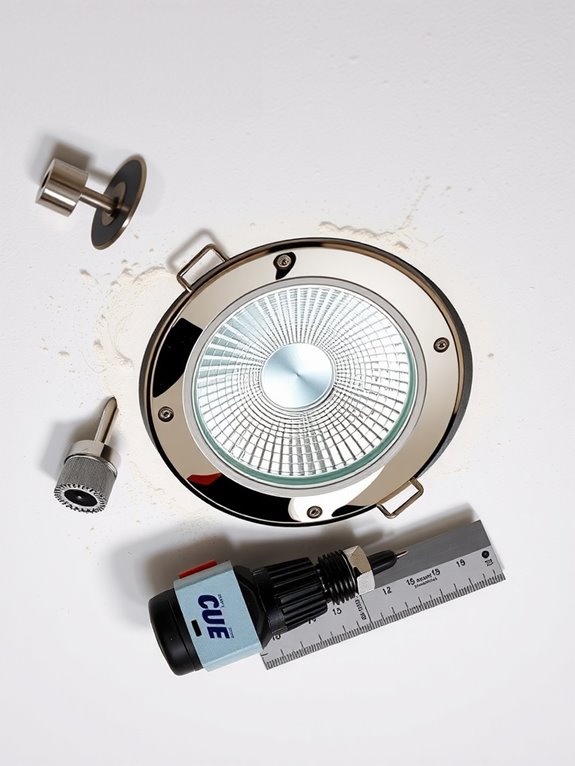
An adjustable hole saw works really well when you need to cut circular openings in drywall for recessed lights. These tools let you change the size to fit different bathroom fixtures, which saves you from buying multiple hole saws.
Adjustable hole saws save money by fitting different bathroom fixtures without buying multiple tools.
Before you start cutting, mark where your hole goes and use a stud finder to check for joists or pipes underneath. This takes just a couple minutes but prevents drilling into something you shouldn’t.
Drill a pilot hole first, then attach your adjustable hole saw. Rotate it slowly so you get a clean edge rather than a jagged one. The DeWalt D180002 adjustable hole saw runs around $40 and handles sizes from 1¼ to 2¼ inches, which covers most standard can lights.
Drywall dust gets everywhere, so tape painter’s tape around your marked spot and use a dust shield or shop vac attachment. You’ll still get some mess, but it keeps cleanup from taking forever.
Once your hole is cut, test-fit your can light housing to make sure it sits properly. A hole that’s too small won’t let the fixture seat right, and too large means the trim ring won’t cover the gap.
Taking your time with this step means you won’t have to patch and re-drill later, which is way more work than getting it right the first time.
Create a DIY Dust Shield for Cleaner Cutting
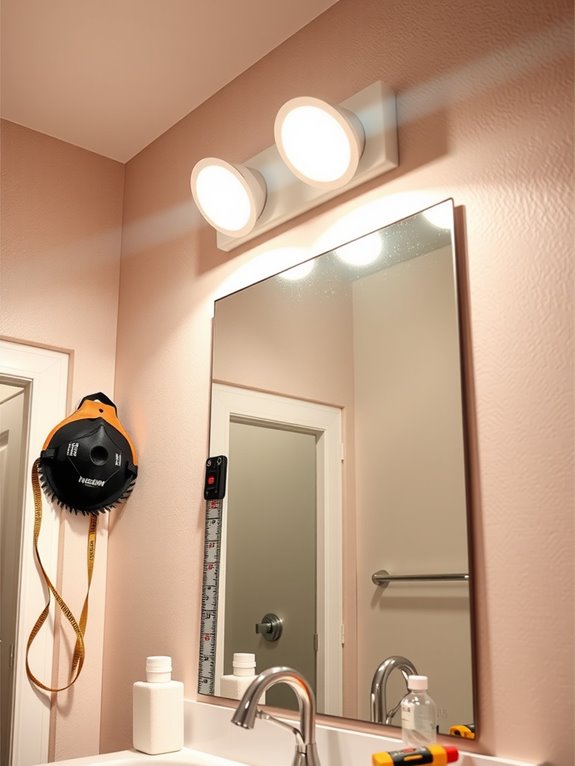
You can make a simple dust shield by cutting a basketball in half. It’s one of those tricks that actually works and saves you from coating your bathroom in drywall dust. A standard basketball costs around $15-25, so it’s cheap enough that you won’t worry about ruining it.
Position the curved side facing down under your cut line. The dust falls straight into the shield instead of floating everywhere. This matters more than you’d think when you’re drilling holes for recessed lights—the last thing you want is white powder settling on your tile, fixtures, and the floor.
Keep your safety glasses and dust mask on the whole time. A good dust mask runs about $5-15 for a pack, and it actually makes a difference when you’re working indoors. The combination of the shield and the mask keeps most of the mess contained so you can focus on making accurate holes instead of planning your cleanup strategy.
Basketball Half Shield Design
Ever notice how drywall dust seems to go everywhere when you’re cutting holes for recessed lighting. A basketball half shield solves this problem nicely. Cut a basketball in half and you’ve got a curved dust shield that works well for bathroom installation.
Here’s how to set it up:
- Position the shield directly above your cut line
- Secure it with tape or clamps so it stays put
- Angle it to funnel dust away from your face and work area
- Make sure the hole saw rotates freely underneath without hitting the shield
The curved design catches debris before it falls into the room or onto you. The basketball’s shape naturally directs dust downward into the shield rather than letting it float around your bathroom. Once you finish cutting for your recessed lighting, remove the tape, detach your dust shield, and dispose of the collected debris. You’ll notice less dust settling on surfaces and a much quicker cleanup afterward compared to cutting without any protection.
Dust Capture During Drilling
Want to keep your bathroom from looking like a flour factory while you’re cutting holes for recessed lights? A simple dust shield makes a real difference. Cut a half basketball in half lengthwise, then position it above your head so it lines up with your drywall cut line. Hold it steady while you work, and the curved surface will catch most of the dust before it settles on everything.
Start by drilling your holes, then use your hole-cutting tool to create each opening. The shield captures the debris as you work, which means less sweeping afterward. Once you finish mounting and wiring the lights, just remove the tape holding your shield in place and put it away for the next project.
The whole setup costs almost nothing since you probably have a basketball lying around already, or you can grab one for about ten to fifteen dollars at any sporting goods store. It’s not fancy, but it works because physics handles the heavy lifting—dust wants to fall down, and a curved barrier sends it where you want it to go instead of onto your face and floor.
Protective Gear and Safety
How much dust can actually fly around when you’re drilling holes in your bathroom ceiling? Quite a bit, as it turns out. That’s why protecting yourself matters during can light installation.
Respirator Mask
Wear one to keep dust out of your lungs while cutting drywall. A basic N95 mask runs about $1-3 per mask, though reusable respirators with replaceable filters cost $20-40 upfront and last longer if you do this work regularly.
Ear Protection
ISOtunes ear protection blocks loud drilling and cutting noise safely. These cost around $100-150 depending on the model, and the wireless versions let you hear people talking while still protecting your hearing from tool noise.
Tool Organization
A Toughbuilt Cliptech tool belt keeps your hole saw and connectors within arm’s reach. This runs $30-60 and means you’re not constantly climbing down your ladder searching for what you need next.
DIY Dust Shield
Cut a half basketball in half to form a curved barrier above your head. This simple setup catches debris before it falls on you and costs just $5-10 for the ball itself.
Your safety tools work as a system. The respirator handles dust, ear protection guards your hearing, and organization keeps you moving efficiently without unnecessary trips up and down the ladder. Building these habits now means you’ll feel prepared when tackling this project on your own.
Locate Your Power Source by Finding Existing Pendant Wiring
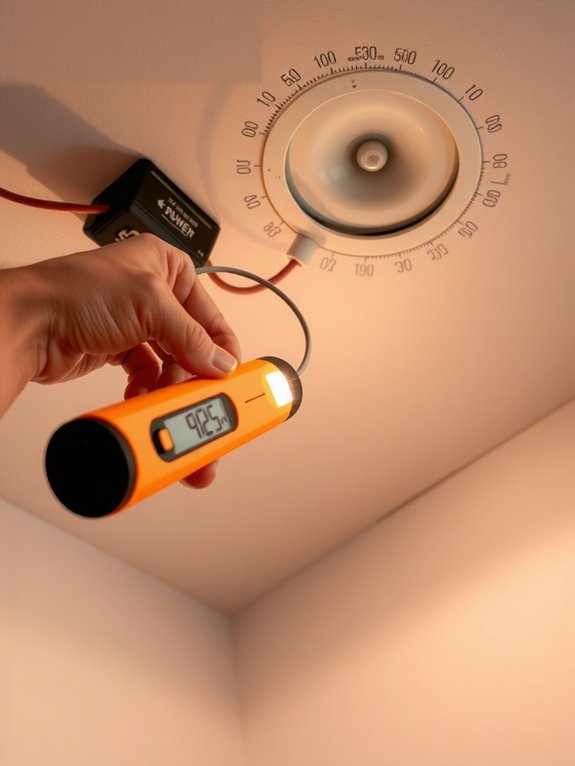
Before you wire up those new can lights, you need to find where your power actually comes from. That old pendant fixture you’re replacing is the easiest way to locate it. Turn off the circuit at your breaker first, then remove the fixture carefully.
Once you take it down, you’ll find the junction box behind it with color-coded wires inside. Black wires carry the hot circuit power that makes things work, white ones are neutral, and bare copper handles ground for safety. Most bathroom pendant setups run on constant power rather than a switch loop, which means your new lights will stay on whenever the breaker’s active.
Knowing your existing wiring setup before you start prevents mistakes that could be expensive or unsafe. You’re basically reading your home’s electrical story before you write the next chapter with those new lights.
Run Romex Between Each Light Location
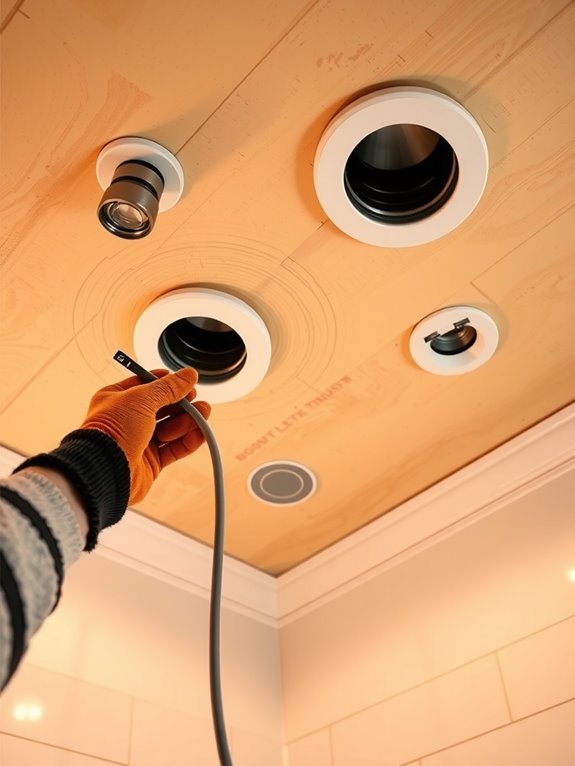
Now you’ll run your Romex cable through the attic space, connecting each light location in sequence. The power flows naturally from one fixture to the next, like a relay race but with electricity. Route the cable carefully along the joists and keep it spaced properly to avoid accidental damage from nails, screws, or foot traffic if someone wanders up there later.
Leave about 6–8 inches of slack at every box for clean connections. This matters more than you’d think because cramming wire into a tight space is annoying and makes future adjustments a pain. The daisy-chain approach keeps your wiring hidden and means fewer junction boxes cluttering up your ceiling, which beats running separate feeds all over the place and dealing with visible boxes everywhere. You’ll appreciate the cleaner look when you’re done.
Routing Through Attic Space
Once you’ve marked your first fixture location and cut your holes, you’re ready to run Romex cable through the attic from one light to the next. The way you route these wires matters for both how your installation looks and whether it meets electrical code.
Start by taking the most direct path between light locations. You’ll want to steer clear of joists and any sharp edges—they can puncture cable insulation pretty quickly. I’ve seen perfectly good runs get damaged because someone tried to squeeze around a beam instead of routing around it properly.
Leave yourself 6 to 8 inches of slack at each hole. This gives you room to adjust connections later and makes troubleshooting way easier if something needs fixing down the road. When you bend the cable, keep those curves gentle—nothing tighter than 1¼ inches. Tight bends pinch the insulation and create heat buildup, which nobody wants.
Use your attic access to pull the wires down into your ceiling cuts as you go. Keeping runs at roughly the same depth helps everything look organized and makes it simpler to locate wires if you need to work in the attic again later. This kind of systematic approach might take a bit longer upfront, but your future self will appreciate not having to puzzle out a tangled mess of cables in five years.
Maintaining Proper Wire Spacing
With your holes cut and your routing plan in place, it’s time to pull that Romex cable between your first and second fixture locations. Start by leaving 6–8 inches of slack at each end for connections. This extra length gives you room to work without forcing the cable into tight spots where it might get damaged.
As you run the cable through your ceiling space, keep it aligned with the joists—they’ll act as your natural guide. Your Romex routing should follow a straight path without sharp bends that could damage the insulation. Think of it like laying a rope down a hallway. You wouldn’t throw it in loops and kinks, right? Same idea here.
Securing the cable with staples every 4.5 feet keeps everything organized and prevents sagging. Most people grab standard cable staples (usually under $10 for a box of 50) from any hardware store, and they work fine. The spacing requirement isn’t just about neatness—it keeps the cable from moving around inside the walls and rubbing against sharp edges that could wear through the outer sheath over time.
When you’re routing between locations, resist the urge to take shortcuts through tight spots or around obstacles. Straight runs through accessible areas make future adjustments way easier if you ever need to swap out a fixture or troubleshoot a problem. Future you will appreciate present you for taking the extra few minutes to do it right.
Connecting Sequential Light Locations
How do you connect multiple can lights without turning your ceiling into a wiring maze? The answer is careful Romex routing. You’ll want to daisy chain your fixtures together in an organized way.
- Run Romex from your first light location to the second, leaving 6–8 inches of wire at each connection point
- Route cable through attic space to each subsequent light, keeping everything neat and out of sight
- Reuse existing pendant fixture wiring as your feed point to simplify the setup
- Secure Romex with staples or conduit, protecting it from sharp edges according to local code
After routing everything, you’ll need to terminate the conductors securely at each location. Before you mount the fixtures, perform continuity testing on your entire run. This test confirms that electricity can flow all the way through your circuit without problems. Think of it like checking that water flows properly through all the pipes before you turn on the shower for real. Once that test passes, you know your setup is safe and ready to go.
Strip Wires and Connect Romex at Each Fixture Location
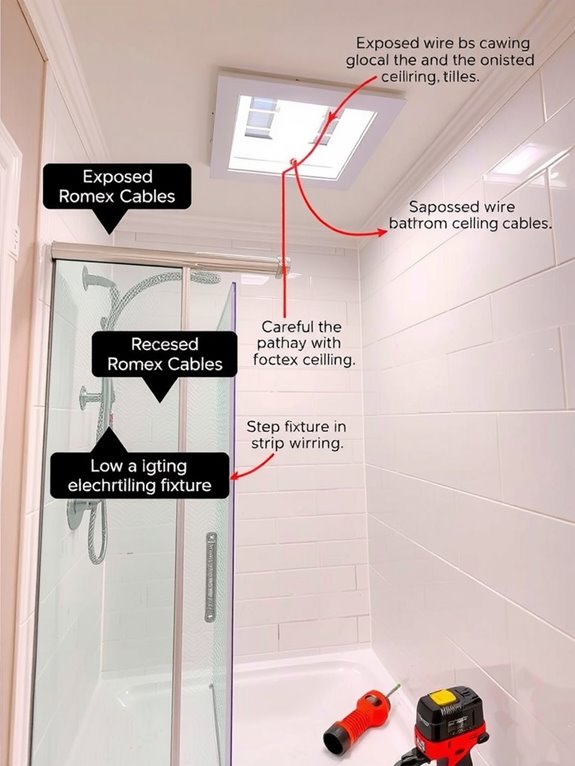
At each fixture location, you need to expose the copper wires inside your Romex cable so they can connect to the light fixture. A wire stripper tool costs around $5–$15 and is worth having because it prevents nicking the copper or accidentally breaking strands, which weakens the whole connection. Strip about 3/4 inch of insulation from each conductor—no more, no less.
Match up the Romex conductors with the fixture leads. They should pair by color: black to black, white to white, and so on. Use wire nuts or connectors to secure them together, twisting firmly until they feel snug and won’t budge. Standard wire nuts run about $1–$3 per pack and come in different sizes depending on how many wires you’re connecting.
Before you move to the next fixture, leave 6–8 inches of extra Romex sticking out beyond the hole. This slack gives you room to work with when connecting additional fixtures without pulling too hard on the connections.
As you run your wiring through attic space, keep it away from joists and sharp edges. Route it carefully to prevent future damage. Poor routing is one of those things that seems fine at first but causes headaches later when you’re troubleshooting a flickering light.
Mount LED Recessed Discs With Spring Clips
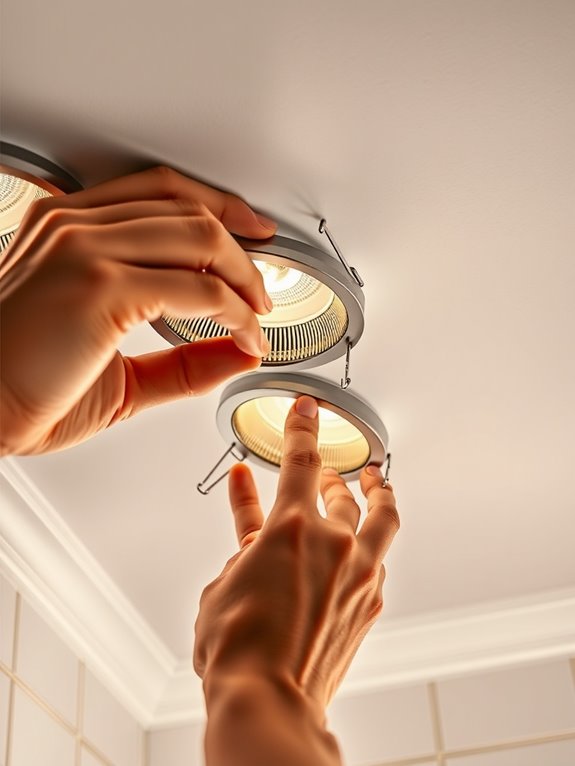
Position your LED recessed disc into the hole you’ve cut, making sure it sits centered and level with the ceiling. This step matters because a flush fit keeps your light beam working properly, especially in bathrooms where you want even lighting across mirrors and countertops.
Push the fixture upward gently until the spring clips on both sides compress and grip the drywall. You’ll feel a bit of resistance, which is normal—that’s the clips doing their job. The springs should compress evenly on each side. Before you move to the next fixture, take a quick look from below to confirm everything caught properly and the disc sits flush against the ceiling with minimal gaps.
Once mounted securely, remove the mounting tape and complete your wiring connections. The built-in transformer powers everything right away, so you can adjust your color temperature immediately without waiting for additional equipment. Your bathroom install is nearly finished at this point.
Test All Your Lights and Dial In Color Temperature
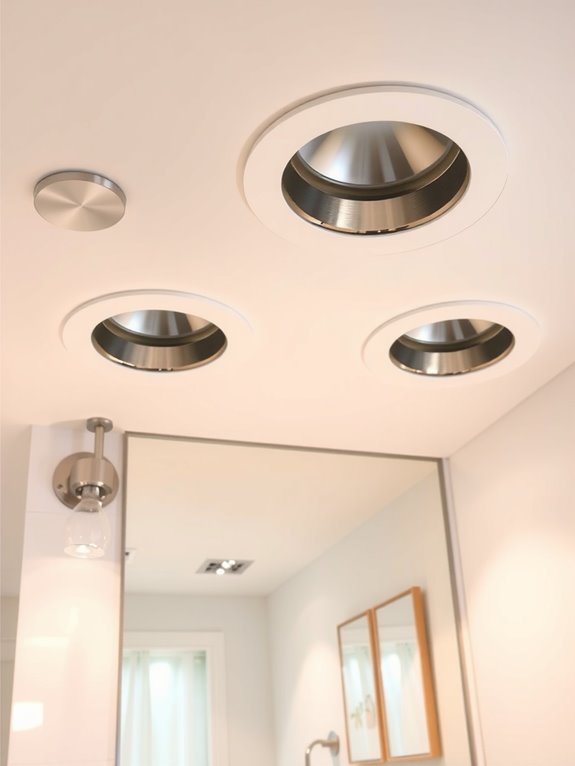
Why settle for bathroom lighting that flips between harsh and dim depending on the time of day? Start by testing each recessed light one at a time to make sure everything actually works. Flip the switches, look for any fixtures that don’t turn on, and note which ones need attention before you move forward.
Once you know the power’s reaching every light, grab a compatible dimmer—something like the Lutron Caseta ($60–$80) works well for most standard fixtures. Adjust the brightness in each zone separately. Your vanity area needs bright light for tasks like shaving or applying makeup, while other areas like the toilet zone can stay softer and gentler on the eyes.
The color of the light itself matters more than people realize. Set the lights directly above your vanity to 2700–3000K, which keeps skin tones looking natural and flattering instead of washed out or shadowy. Shower and toilet areas can go a bit brighter at 3000–3500K since you’re not looking closely at your face there. Aim for a CRI (Color Rendering Index) of 90 or higher at your vanity so colors actually look the way they should. For other areas, 85–90 is perfectly fine.
Keep the color temperature feeling the same throughout each zone instead of jumping around. Adjust individual lights until the whole room feels balanced and welcoming, so you don’t dread looking in the mirror during your morning routine.
Troubleshoot Common Recessed Lighting Issues
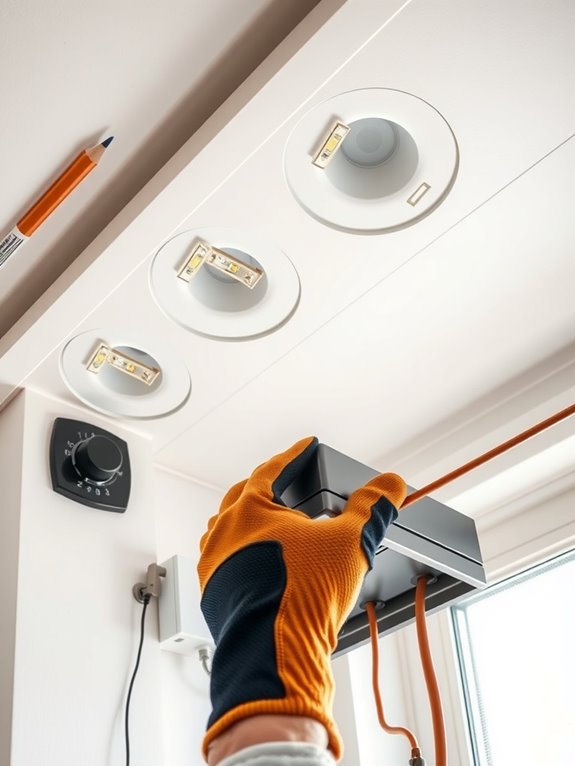
Even after you’ve dialed in your perfect lighting setup, recessed lights don’t always cooperate—and bathroom humidity doesn’t help matters. You’ll want to tackle issues head-on before they worsen.
Buzzing or humming sounds often mean loose can housings or incompatible dimmer compatibility. Start by tightening all connections where the housing meets the ceiling. Then verify your dimmer matches your bulbs. If you’re running LED bulbs, for example, you’ll need a dimmer rated specifically for LEDs—standard dimmers from the hardware store just won’t cut it.
Moisture damage happens when you skip wet-rated fixtures in bathrooms. Always choose moisture-rated housings with proper IP ratings, especially for areas near showers or tubs. The extra cost upfront beats replacing fixtures down the road when water seeps in and causes damage.
Flickering lights usually signal dimmer problems. Swap in a compatible dimmer designed for recessed lighting and your specific bulb type. Sometimes the issue is simply that the dimmer isn’t compatible with LEDs or your particular bulb wattage.
Dark spots appearing indicate water intrusion. Check the seals around your fixtures and make sure they sit outside spray zones. If moisture is getting in, water will eventually damage the fixture’s wiring and housing.
These fixes keep your bathroom lighting reliable and safe for years ahead. Catching problems early saves you time and money later.