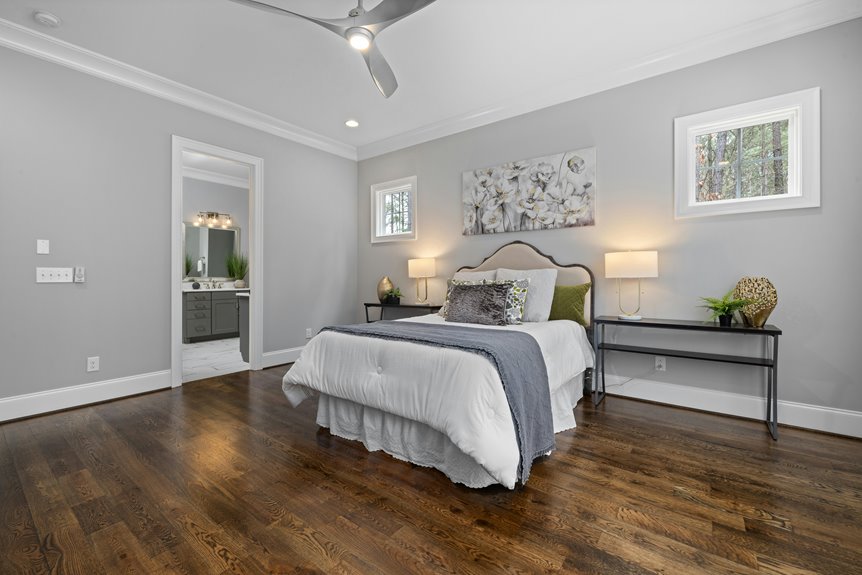
An en suite is your private bathroom attached straight to your bedroom—no hallway trips or waiting in line. You get privacy during morning routines and a spa-like feeling without spending a fortune.
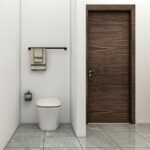
The layout matters more than you’d think. Position the door far from your bed so people walking in don’t get a direct view of where you sleep. A pocket door (typically $150–$400) slides into the wall instead of swinging open, which saves floor space in smaller bedrooms. Keep all plumbing on one wall to simplify installation and reduce costs during construction.
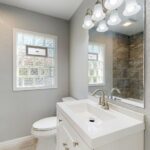
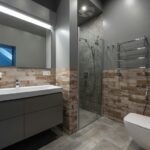
Pick fixtures that match your bedroom’s color scheme. A short-projection toilet takes up less visual space and pairs nicely with compact sinks and vanities. The goal is creating a room that feels connected to your bedroom rather than tacked on as an afterthought.
Moisture is the real challenge in en suites. Without proper ventilation, humidity creeps into your bedroom and can damage walls or create mold. Install a quality exhaust fan and run it during and after showers. A window helps too if your bedroom has one nearby, since fresh air moves moisture out naturally.
What an En Suite Bathroom Is
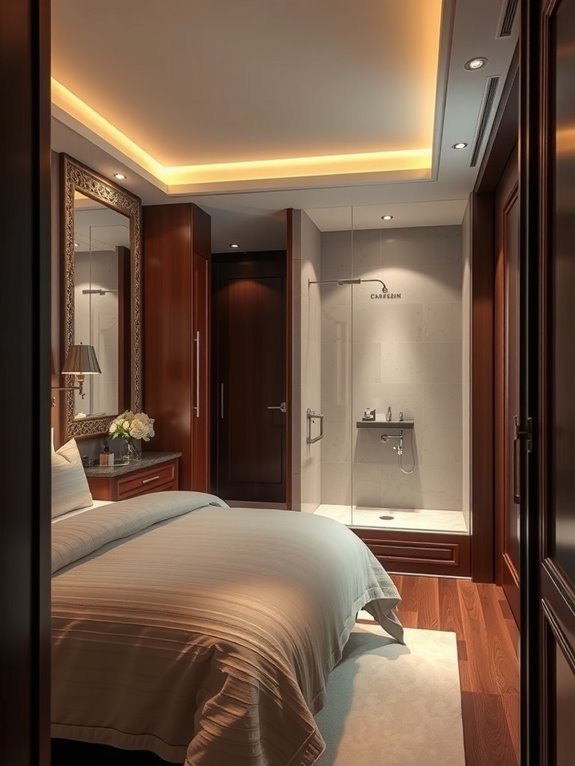
Ever wonder what makes some bedrooms feel like a luxury hotel suite? That’s the appeal of an en suite bathroom. You’ve got a private bathroom attached directly to your bedroom—no hallway trips, no sharing with guests. It’s just you and your personal spa space.
An en suite bathroom is only accessible from the bedroom itself, which creates that exclusive feeling. You’ll find them most often in primary bedrooms, though larger homes sometimes include them in basement or attic guest suites too.
What makes en suites so appealing? Privacy, mainly. You can freshen up without bumping into anyone else. They also boost your home’s value and make mornings run smoother. Whether you’re designing a new bathroom or reimagining your bedroom layout, an en suite changes how you experience your personal space.
Key Advantages of Adding an En Suite
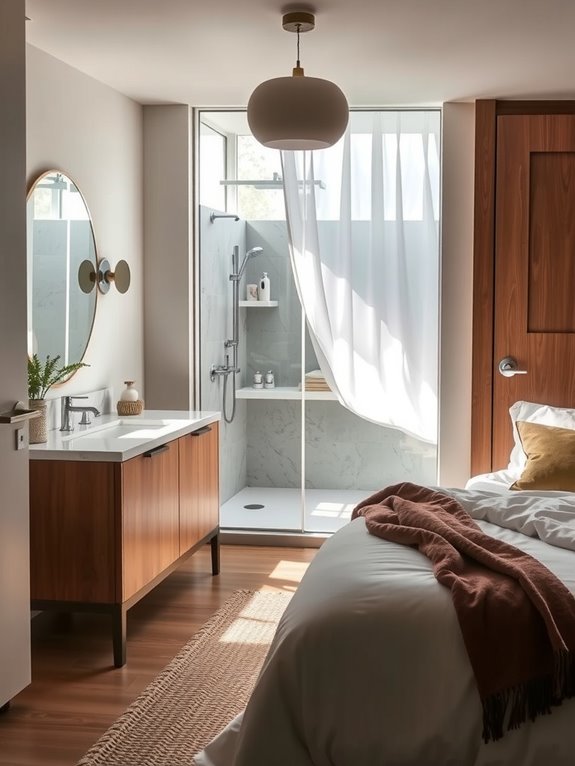
Now that you understand what an en suite bathroom actually is, let’s talk about why you’d want one. Having a private bathroom attached to your bedroom means you skip the hallway trips and waiting lines that come with shared bathrooms. This matters more when you’ve got multiple people getting ready at the same time. The space becomes your own retreat—a quieter, more private area where you can start and end your day without an audience.
Beyond the daily convenience, en suites add real value to your home. Real estate agents often point out that buyers see them as a luxury feature, even if it’s just a basic setup with a toilet, sink, and shower. A simple en suite with standard fixtures like a $300-500 pedestal sink and basic tile work can still make your home more appealing to future buyers than an identical house without one.
The privacy factor is worth mentioning separately if you live with roommates, family members, or a partner with different schedules. You’re not coordinating bathroom time or rushing through your routine because someone else is waiting outside the door. It’s the kind of small freedom that feels pretty good in everyday life.
Realistic Drawbacks and How to Avoid Them
Realistic Drawbacks and How to Avoid Them
When your en suite becomes your home’s only bathroom, you’ll run into some real problems. Guests need bedroom access to use it, which means privacy takes a hit. Steam from showers seeps into your sleeping space and can lead to mold and odors. Poor door placement makes you feel exposed when you’re trying to sleep. A cramped layout creates daily frustration, and temperature swings can disrupt your rest at night.
| Challenge | Impact | Solution |
|---|---|---|
| Single bathroom stress | Guest discomfort | Add half-bath elsewhere |
| Privacy erosion | Bedroom exposure | Install solid doors, frosted glass |
| Steam damage | Mold, odors | Upgrade ventilation fans |
| Layout cramping | Daily friction | Plan generous fixture spacing |
| Heat management | Sleep disruption | Add exhaust systems |
The good news is that planning ahead prevents most of these headaches. Start with ventilation. A quality exhaust fan like the Panasonic WhisperCeiling (around $150–$300) pulls moisture out before it settles into your bedroom. Position your bathroom door away from your bed so you’re not staring at the entrance while sleeping. Give yourself real space between fixtures—the toilet, sink, and shower shouldn’t feel squeezed together. Your en suite should feel like a place you actually want to spend time in, not a tight squeeze you tolerate.
Where to Locate Your En Suite
The spot you pick for your en suite really does matter, so it’s smart to think it through before you start taking down walls. Your best location depends on what your home’s layout actually allows.
The primary bedroom is the most popular choice since it keeps things private and puts the bathroom right where you’ll use it most. You could also look at converting an adjacent room or finding space in an awkward corner that doesn’t work well for anything else. Some people even squeeze compact bathrooms into closets or underused wardrobes when they’re tight on space.
Before you commit to a location, identify any load-bearing walls and map out where your plumbing already exists. This matters because moving pipes costs money fast, so you want to work with what you’ve got rather than against it. Taking time to look at your current water lines and drainage routes means you won’t end up paying for expensive changes down the road.
Permits, Plumbing Logistics, and What to Expect From Contractors
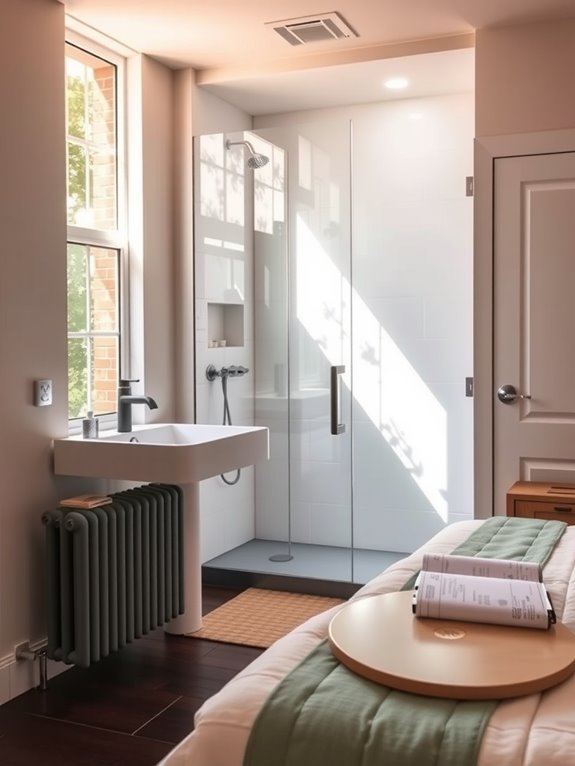
Before you start breaking down walls, you’ll need to understand what permits and approvals your en suite actually requires. Building Regulations approval is almost always necessary, though planning permission often isn’t. It’s worth checking with your local council to be sure, since requirements vary by location.
Your plumber will assess how to route those supply and waste pipes without creating a logistical nightmare. This means checking your existing pipes and figuring out the most efficient path to your new fixtures. Some plumbers charge $100–$200 for an initial assessment visit, which helps them give you an accurate quote.
When you’re hiring contractors, be clear about expectations upfront. Ask about their certifications—some plumbers can self-certify through competent persons schemes, which means they’ve met specific training standards. Get multiple quotes from different plumbers so you can compare pricing and services. Ask for references from past en suite projects, and actually call those references. A plumber who’s handled bathroom work before will know the common headaches and how to avoid them.
Building Regulations And Approvals
Before you pick out your new bathroom fixtures, you’ll need to know that Building Regulations approval is typically required—even when planning permission isn’t needed. The difference matters because they’re two separate processes, and skipping one can cause real headaches down the line.
Some tradespeople can self-certify their work, which means they’ve proven they know what they’re doing and can sign off on their own installations. Before hiring anyone, check the competent persons register to see if they’re listed. This saves you the time and money of having to get a separate inspector to approve the work yourself.
Your contractor should handle most of the paperwork and inspections involved. That said, understanding what Building Regulations actually cover helps you stay in the loop. These rules address ventilation, heating systems, water safety, electrical work, and structural changes. They exist because a bathroom that looks nice but leaks or has poor airflow will damage your home over time. It’s less about red tape and more about making sure your investment works properly and safely. Think of it as a checklist that catches problems before they become expensive fixes.
Plumbing Route And Assessment
Once you’ve sorted out Building Regulations, the real work starts: figuring out where your pipes actually go. Your plumbing route and assessment determines how complicated your project will be and what it’ll cost.
The main question is straightforward: can you run supply and waste pipes efficiently to your new en suite. Ideally, you’ll place the soil pipe near existing drains so you don’t tear up more of your home than necessary. If the nearest waste stack is below you or sits far away—especially on upper floors—you might need a macerator (around $300-500) or a pump system (typically $400-800). These cost more upfront, but they solve real problems when gravity won’t do the work for you.
Smart contractors usually suggest keeping all your plumbed items on one wall or sharing drains with a bathroom next door. This approach cuts down disruption to your home and keeps your costs reasonable. Before you commit to any plan, get quotes from at least two or three plumbers about their routing assessment. Different contractors see different solutions, and comparing their approaches helps you understand what makes sense for your space.
Contractor Selection And Expectations
Who’s actually going to build your en suite—and will they know what they’re doing? Finding the right contractors matters more than you’d think. You’ll want people who’ve tackled en suite projects before and can handle the whole package: plumbing, waterproofing, ventilation, and heating trades.
When you’re vetting contractors, look for verified experience with bathroom renovations and en suite installations. Ask if they’re on a competent persons register, which means they can self-certify their work. This saves you time and money because you skip the waiting period for Building Regulations approval. Get detailed, itemized quotes that break down costs and timelines so there are no surprises later. Good contractors will also explain upfront how much disruption you can expect in your existing rooms during the work.
Request references from past projects and actually call those people. A contractor who’s worked on three en suites in the past year knows the common problems and can solve them faster than someone doing their first one. You’re building a partnership here, not just hiring labor, so communication matters. Ask how they’ll keep you updated on progress and what happens if something unexpected shows up during construction, like old pipes or water damage behind the walls.
En Suite Layout: Privacy and Flow Through Door Placement
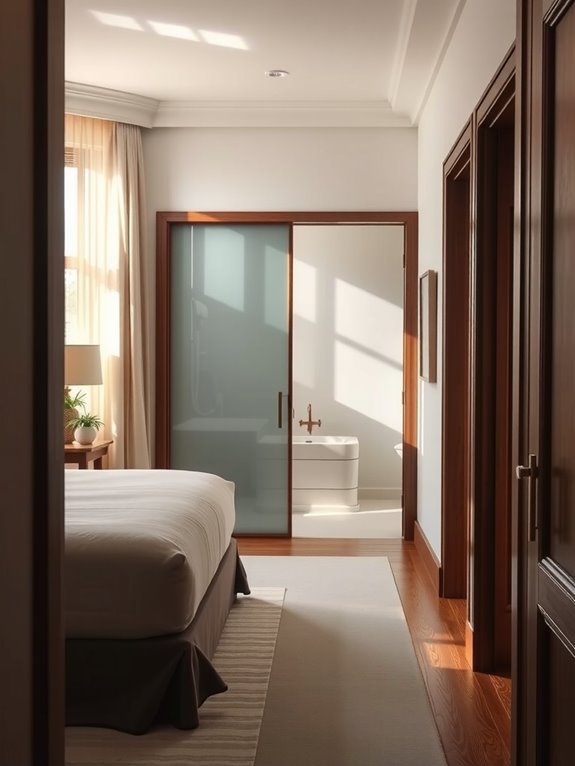
When you’re planning where to put your en suite door, location matters more than you might think. The best spot is as far from your bed as possible. This keeps you from seeing straight into the bathroom when someone opens the door, and it reduces sound and light from leaking into your sleeping space at night.
Instead of a regular hinged door that swings into the room, consider a pocket door or sliding door. These options take up way less space since they slide along the wall instead of swinging out. You get better control over how the opening affects your bedroom’s feel and privacy. Pocket doors typically cost between $150 and $400 depending on quality and installation, while sliding barn-style doors run $200 to $600. Both are worth the extra investment if your bedroom layout allows for them.
Door Placement Strategy
Where you position that en-suite door makes a bigger difference than you’d think. Strategic door placement shapes how your bedroom feels—private, spacious, and genuinely yours.
Distance from bed: Position the door as far from your sleeping area as possible to shield yourself from direct sightlines. If your bedroom layout is tight, even moving the door a few feet can keep you from feeling exposed when you’re in bed.
Transitional space: Create a buffer zone like a small hallway between the door and fixtures. This boosts privacy and sound control without needing major construction. Even a simple curtain rod with a fabric panel costs around $30 to $80 and gives you an extra layer of separation.
Space-saving doors: Choose pocket doors, sliding doors, or pivot doors that won’t swing into your bedroom or clash with furniture. Pocket doors cost between $150 and $400 per door installed, depending on your wall thickness and materials. They disappear into the wall, which saves floor space and prevents that awkward moment when the door blocks your view of the room.
Clear sightlines: Position the door so it doesn’t block access to storage, wardrobes, or key circulation paths. You want to move freely around your bedroom without having to work around an open door.
The goal is creating a space where you control visibility. Smart door placement does the work, and you’ll notice the difference right away—that sense of retreat and personal space becomes part of how you experience your bedroom every day.
Privacy-Focused Layout Design
Your en suite’s placement makes a real difference in how your bedroom feels. When that door sits far from your bed, you won’t catch glimpses of bathroom activity while you’re trying to rest. It’s one of those details that seems small until you’re actually living with it.
Pocket doors and sliding doors work well here because they close quietly without eating up bedroom space like a regular hinged door would. A pocket door costs somewhere between $150 to $400 depending on the quality, while a basic sliding barn door runs $100 to $300. Both close silently, which matters more than you’d think at night.
Think about where your toilet and shower sit, too. Positioning them on a shared wall with the hallway keeps plumbing simpler and moves bathroom openings away from where you sleep. If you have room, a partial wall or niche between the sleeping area and the bathroom acts as a visual barrier without completely blocking everything off. This approach creates actual zones within your space so the bedroom stays a true retreat and not just a room that happens to have a bathroom attached to it.
Flow and Accessibility Balance
When people move through your bedroom, where that bathroom door sits matters more than you might think. The placement affects both how smoothly traffic flows and how private your sleeping area feels.
A few door options work better than others for keeping pathways open. Pocket doors slide completely into the wall, which means they don’t swing out and block furniture or walking space. Pivot hinges let doors open wider without eating into your bedroom layout. If you position the entrance near a room corner, people naturally access the bathroom without cutting through your sleeping zone. An angled entry does something similar—it redirects foot traffic away from your bed area instead of creating a direct line across your personal space.
The goal is simple: visitors shouldn’t feel like they’re walking through your bedroom to reach the bathroom. When you think through door placement before building or renovating, the whole room feels less crowded and more like a real retreat.
Color and Materials for Bedroom Continuity
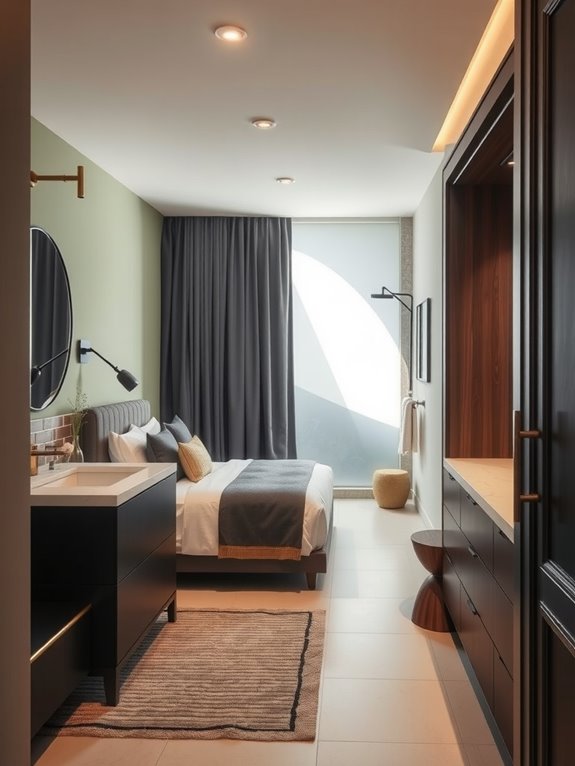
When you’re designing an en suite, the goal is to make your bathroom feel like it belongs in the same room as your bedroom, not like you stepped into a different house. The easiest way to do this is through color and materials that match what you already have.
Start with your bedroom’s color palette. If your bedroom has soft sage walls, you could use sage-tinted tiles on an accent wall or around the vanity. Warm wood tones work the same way—if your bedroom features warm oak, bring that material into your vanity cabinet. Even metal finishes should match: if your bedroom has unlacquered brass fixtures, use brass for your bathroom hardware and light fixtures too.
| Design Element | Bedroom Match | En Suite Application |
|---|---|---|
| Wall Color | Soft sage | Sage-tinted tile accents |
| Materials | Warm oak wood | Oak vanity cabinet |
| Metal Finishes | Unlacquered brass | Brass fixtures and hardware |
Natural materials like marble, stone, and hand-glazed tiles help create that cohesive, handmade feeling you’re going for. These aren’t cheap—marble tile runs about $5 to $20 per square foot, while hand-glazed tiles typically cost $8 to $15 per square foot—but they last a long time and look good while they age.
Don’t forget about light. Skylights or windows bring in natural brightness, which connects your bathroom to the calm, open feeling of your bedroom. Even the small details matter: if your bedroom tiles have grain running in one direction, try matching that pattern in your bathroom. These small choices add up and make the space feel like it was planned out carefully.
En Suite Floor Plans for Small Spaces
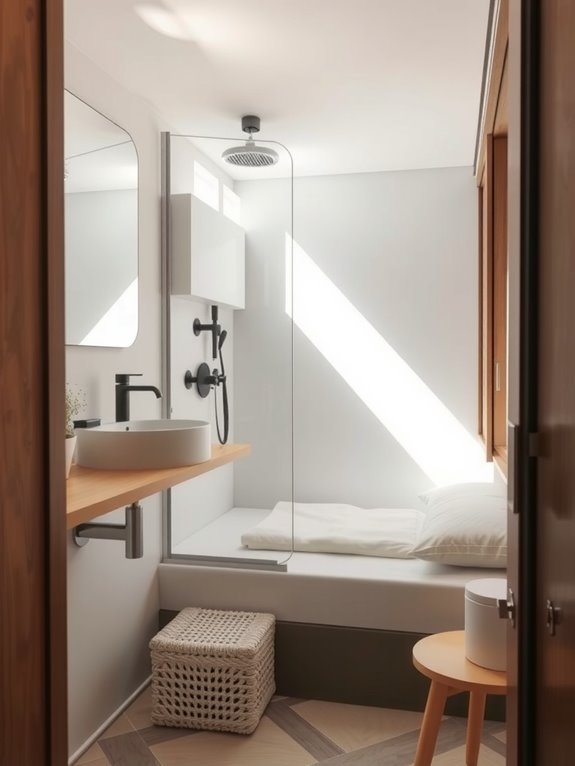
What’s the right size for fitting a full bathroom into your bedroom? You’re aiming for roughly 0.82–1.0 meters of clear space. This tight footprint lets you squeeze in a shower, toilet, and basin while keeping your bedroom feeling like an actual bedroom.
To make the most of your bathroom, consider these practical moves:
- Install a short-projection toilet and wall-hung basin to reclaim floor space. The Duravit Starck 3 short-projection toilet runs around $250–350 and saves about 10 centimeters compared to standard models.
- Position all plumbing on one shared wall, which simplifies installation and reduces costs.
- Use pocket doors or sliding doors instead of swing doors that eat up space. A basic pocket door kit typically costs $150–300 and takes up zero floor space when open.
- Plan carefully for headroom in loft conversions where low ceilings can make shower placement tricky.
Smart layouts work with what you have while giving you full bathroom function. Everything stays within arm’s reach without feeling cramped.