
Start by matching your rug to your furniture setup. A loveseat with an armchair works well with a 5×8 rug, while a full sofa with chaise needs something closer to 9×12. You want the rug to anchor your seating area without looking like it got lost in the room.
Next, think about your room’s layout and how people move through it. Plan for 12–18 inches of bare floor around the edges so the space doesn’t feel cramped, and leave enough clearance for doors to swing open without catching on the rug. Hallways and entryways especially need this breathing room.
Finally, decide between standard sizes like 8×10 for flexibility or a custom rug tailored to your exact space. Standard sizes are easier to find and usually cost less—expect to spend anywhere from $200 to $800 depending on material and quality. Custom rugs run higher but eliminate guessing and fit perfectly against walls or around unusual furniture arrangements. The right choice depends on whether you value convenience or precision in your room.
Choose Your Rug Size Based on Furniture Configuration
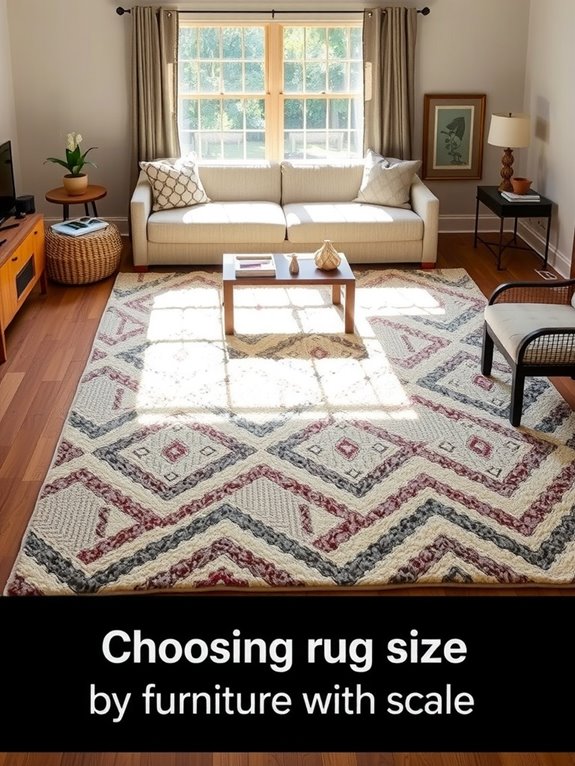
How’s your furniture arranged right now? Your seating setup should guide your rug size choice. If you have a loveseat paired with an armchair, a 5×8 rug works well with the front legs sitting on it. Got a sofa plus loveseat plus armchair? An 8×10 rug keeps everything connected and grounded together.
For a sofa with a chaise, you’ll want to go bigger. A 9×12 rug extends nicely beyond the furniture pieces. In open-concept spaces, a 10×14 works better because it anchors your seating across multiple pieces and creates one cohesive look.
The real trick is making sure your rug extends far enough beyond the furniture to visually unite the seating area. Match your furniture configuration to these guidelines, and you’ll get that anchored, intentional feeling in your living room.
Account for Room Shape, Doors, and Open-Concept Constraints
Your room’s layout matters just as much as your furniture arrangement when you’re picking a rug size. If you’ve got an open-concept space, your rug should define the seating area without blocking walkways. Aim for 12–18 inches of bare floor space around your rug edges so people can move around freely.
Your room’s layout is just as important as furniture when sizing a rug—aim for 12–18 inches of bare floor around edges.
Hallway runners need a different approach. Center them with 3–6 inches of wall space on each side to keep traffic flowing safely.
In rooms with doors, shorter pile heights work better because they won’t catch during door swings. Before you commit, mock up your sizing with painter’s tape first. This gives you a real sense of how the rug will work in your actual space, and it costs almost nothing.
Long, skinny rooms need proportionally sized rugs like 8x10s aligned with your room shape rather than furniture orientation. This creates better visual balance and makes the space feel less awkward.
All these strategies keep your rug complementing your room’s unique shape while letting everyone move comfortably through your space.
Select From Common Sizes (8×10, 9×12) or Go Custom
Once you’ve figured out how your space flows, it’s time to pick an actual rug size. Most living rooms work great with a few standard options. The 8×10 rug is the go-to choice for versatility, fitting most seating areas comfortably. If you’ve got a larger living room with more furniture, the 9×12 rug gives you extra coverage so everything sits nicely on the rug. For tighter spaces, a 6×9 works better.
Now here’s the thing: you don’t have to stick with standard sizes. Custom rugs let you tailor dimensions down to the inch, which is helpful for awkward rooms or when you want a specific layout. Whether you prefer front legs on the rug or bare floor framing around the edges, custom options help you design exactly what works for your space instead of making your space fit the rug.