
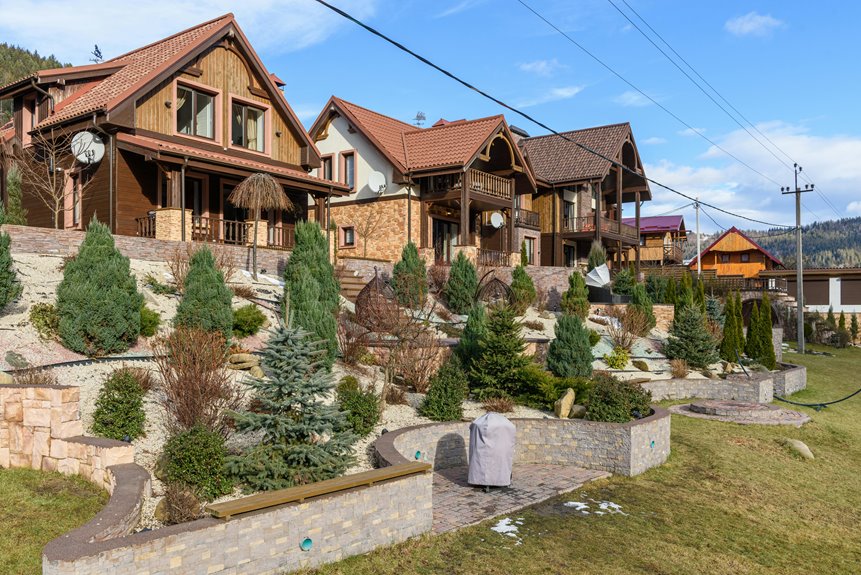
Start by watching your yard during a rainstorm. Where does water collect? Which spots stay dry? This tells you a lot about how your slope naturally drains. Once you understand these patterns, you can work with them instead of fighting them.
Retaining walls create the flat zones you probably want for sitting, playing, or gardening. Concrete blocks run around $5 to $15 per square foot and do the job without fuss. Natural stone costs more—maybe $30 to $50 per square foot—but it blends in nicely if your house has that aesthetic. Pick what fits your budget and your home’s look.
Ground cover and native plants handle erosion while looking good at the same time. Drought-tolerant species need less water and less maintenance once they’re established. This matters more than you’d think when you’re working on a slope.
Design your yard in zones based on how you actually spend time there. Maybe you want a small patio at one level, a garden spot at another, and a play area somewhere else. Layering your backyard this way makes it more useful and easier to manage. The details of what goes where depend on your specific slope, your family’s habits, and what matters to you.
Map Your Slope Grade and Drainage
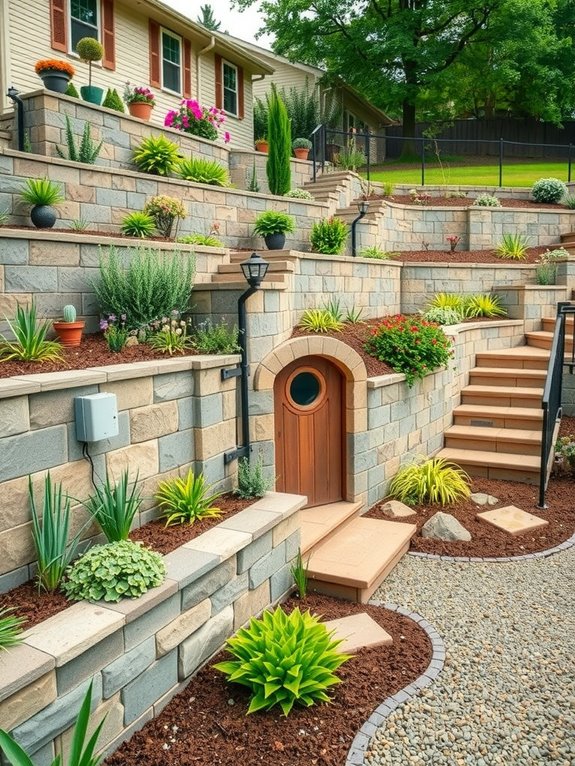
Before you start digging into your sloped backyard, take time to understand what’s actually happening on that hillside. When you map out your slope grade, you’ll see exactly where the ground rises and falls. This information tells you the best spots for terraces and retaining walls.
During the next rainstorm, watch where water naturally flows and pools. Water tends to collect at low points, and that’s where you’ll need to focus your grading and drainage work. Pay attention to these patterns, and you’ll know where problems might happen later.
Check your soil depth in several different spots across the yard. Deeper soil is better for retaining wall foundations and helps with drainage aggregate placement. Write down what you find and create a site plan that shows each level, the materials you’ll use, and how everything connects.
Before finalizing your plan, locate any buried utilities and tree roots. Call 811 or your local utility locating service to mark underground lines—hitting a gas line or electrical cable gets expensive fast. Mark these spots on your map along with any access paths you’ll need for future maintenance and repairs.
This careful planning turns the project into something you can actually build without surprises derailing your progress.
Build Flat Space With Retaining Walls or Patios
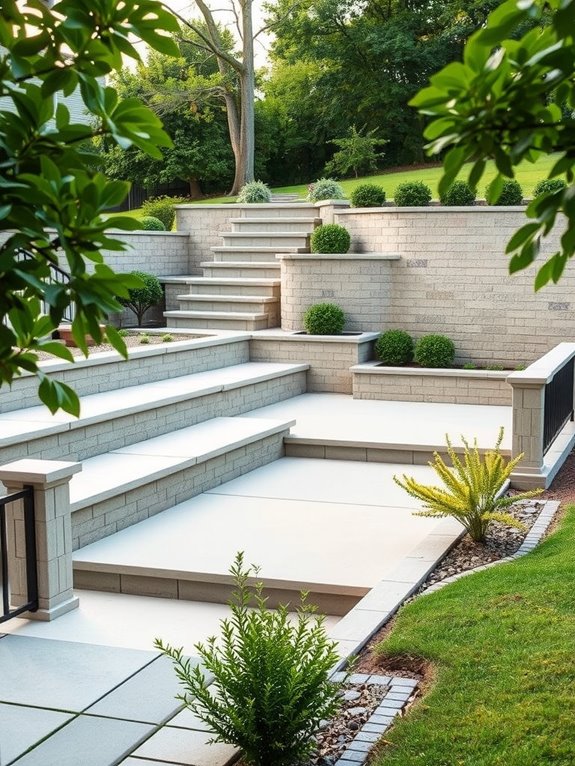
How’d you like to turn that steep slope into actual usable space? Retaining walls do exactly that. They carve out multiple flat levels in your backyard where you can relax and play.
Retaining walls transform steep slopes into multiple flat levels—turning your backyard from awkward to usable.
You’ve got options here. Natural stone looks gorgeous but costs more—expect to spend $25 to $50 per square foot depending on the type. Concrete blocks offer budget-friendly durability at around $10 to $15 per square foot and stack easily if you’re doing it yourself. Timber gives a softer, natural feel for $15 to $30 per square foot, though it needs more maintenance over time. Each material handles water drainage differently, so pick one that matches how your yard naturally drains.
Start with a functional patio on the main level. This becomes your gathering spot. Then add terraces climbing upward, pairing them with terraced planting beds. The beds manage water runoff while giving you perfect spots for flowers and shrubs at each level.
This approach builds your backyard in phases. You’re not overwhelmed, and your slope finally becomes an asset instead of a hassle. Getting professional guidance on drainage and structural support is worth the cost—mistakes with water flow and stability get expensive fast.
Choose Materials That Match Your Style and Budget
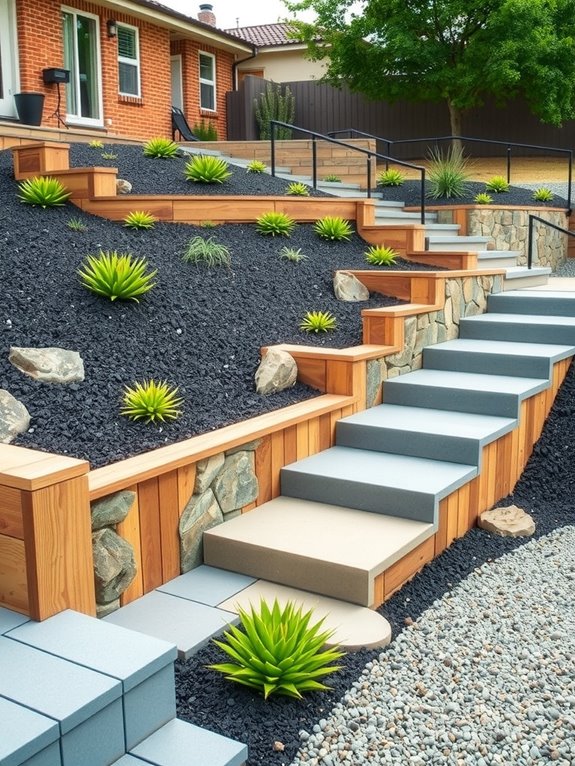
What you build your retaining walls with matters just as much as where you build them. Your material choices shape how your sloped backyard looks and how much you’ll spend.
Natural stone has that classic, elegant feel but costs more upfront—expect to pay $20 to $50 per square foot depending on the stone type. Timber gives you warmth and costs less initially, around $10 to $25 per square foot, though you’ll need to treat it every few years to prevent rot. Concrete blocks land in the middle. At roughly $5 to $15 per square foot, they’re budget-friendly and hold up well in most climates without constant upkeep.
Your home’s existing style should guide your choice. A brick house looks best with matching brick pavers. A modern home benefits from clean concrete lines. This kind of visual match actually protects what your house is worth when you eventually sell.
Start with the walls you need most—the ones doing the heavy work of drainage and preventing erosion. Once those are done, you can add your terraced garden in phases as your budget allows. Build one section, let it settle, then add the next section when you have the money. This approach keeps the project from becoming stressful or draining your savings all at once.
Plant for Erosion Control and Visual Impact
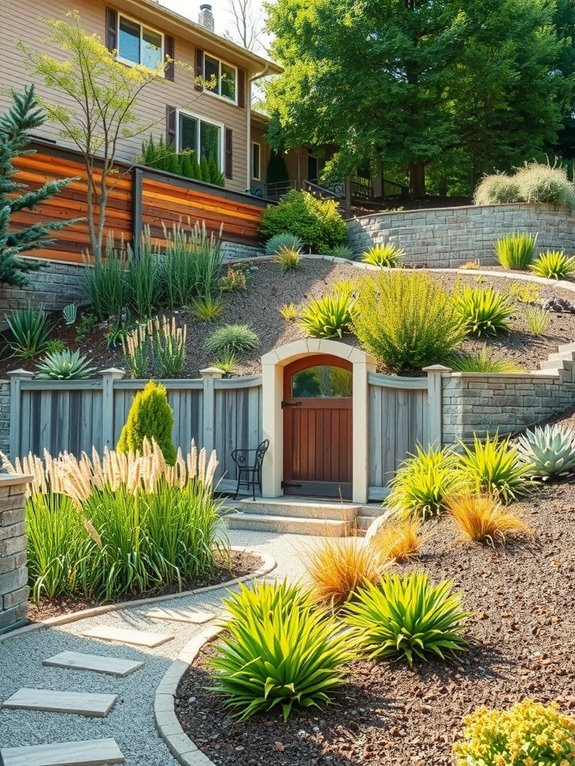
Once your retaining walls are in place, plants do the real work of holding everything together. Pick native plants and drought-tolerant varieties—they stabilize soil while keeping your maintenance schedule reasonable. Groundcovers work particularly well on slopes because they prevent erosion and add visual interest across terraced areas without demanding much attention.
Native plants and groundcovers do the heavy lifting—stabilizing soil while keeping maintenance minimal on sloped terrain.
Rocks and boulders serve double duty on a slope. They anchor the soil in place and help water drain naturally instead of pooling on the surface. Position larger stones strategically rather than scattering them randomly, and you’ll notice how much more intentional the slope looks.
For watering, a drip irrigation system with pressure-compensating emitters beats hand-watering or standard sprinklers. These systems deliver water slowly at the soil level, so less runs off downhill and gets wasted. Budget around $150 to $300 for a basic system covering a medium-sized slope, depending on the area you’re covering. The initial investment pays for itself through lower water bills over a season or two.
The combination of native plants, strategically placed rocks, and efficient watering creates a slope that handles rain without eroding while looking like a natural part of your yard.
Design Multi-Level Zones That Fit Your Lifestyle
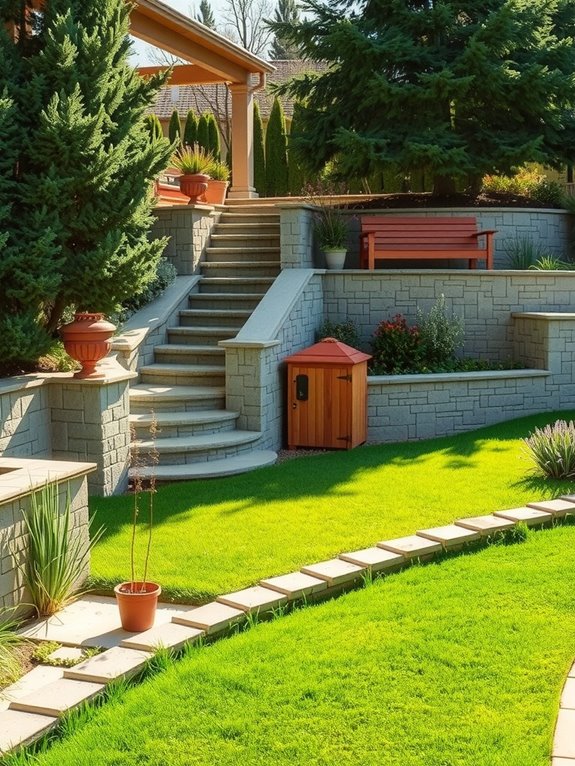
Why settle for a flat backyard when you can build one that actually fits how you live? A sloped yard gives you a real advantage. By designing multi-level zones with retaining walls, you create separate spaces that work for your lifestyle. Your lower seating area becomes the gathering spot, while a mid-level garden offers a quieter place to hang out. An upper deck works well for watching sunsets.
This tiered design handles three important jobs at once. It manages water drainage so puddles don’t stick around, prevents erosion from rain washing things away, and gives you way more usable outdoor space. Connect each level with curved pathways and stone steps that feel natural to walk on. Add terraced planting beds at different heights for both stability and color throughout the seasons.
For the retaining walls, concrete blocks run about $15 to $25 per block, while natural stone costs closer to $50 to $150 per block depending on what you pick. Pavers for your pathways typically run $3 to $8 per square foot. Stone steps range from $20 to $100 each based on size and material. The good news is you don’t need expensive materials to make this work. Many people use a mix—maybe stone steps in the main gathering area and simpler concrete elsewhere to keep costs reasonable.
You’re basically building outdoor living spaces that your family will actually use instead of staring at an empty slope.